.jpg)
Miami's premium real estate is some of the smallest in the country. A $3,400-a-month Brickell one-bedroom is often 650–750 square feet. A two-bedroom in a new Edgewater tower is rarely more than 1,100. The same money in Austin or Nashville buys nearly twice the square footage.
What Miami high-rises trade away in size, they make up in architecture — floor-to-ceiling windows, ocean and bay views, ceilings just high enough to be generous, and open layouts that erase the usual living-room-dining-room-kitchen separation. The result is a category of apartment that demands a specific kind of design intelligence: small spaces that have to feel expansive, often without much wall.
The designers who do this well in Miami have developed a vocabulary that's worth knowing whether you live in a 700-square-foot Brickell condo, a 480-square-foot Wynwood loft, or a small space anywhere else in the world that wants to feel bigger. Below are the lessons.
The principle that matters most
Small spaces fail when designers furnish them like small versions of bigger spaces. They succeed when designers recognize that small spaces operate by different rules — visual rules, scale rules, light rules — and lean into them rather than fight them.
A 700-square-foot Brickell condo with one perfectly chosen sofa, three pieces of art, and almost no clutter feels generous. The same condo with five well-intentioned furniture pieces, six rugs in conversation, and a dozen styled objects feels smaller than it is. The math of small-space design is subtractive, not additive. Every choice has to earn its square footage.
1. One hero piece, not five competing ones
The most consistent mistake in small-space design is filling the room with too many pieces of the same visual weight. Three "important" chairs, two "statement" tables, and a "feature" sofa cancel each other out — and worse, they make the room read as crowded because the eye doesn't know where to land.
In a small Miami apartment, pick one hero piece per room and let everything else play supporting roles. A curved sofa, for example, is a hero — pair it with simple side tables, a low coffee table, and minimal decor. A sculptural pendant light is a hero — keep the sofa and chairs visually quiet. The rule of thumb: if you can name more than two pieces in a 200-square-foot living room, you've added too many.
2. Furniture under, not in front of, the windows
Miami high-rises were designed around the view. The single most destructive choice you can make in a small unit is a tall piece of furniture that interrupts the window line — an upright bookcase, a high-backed sofa, a heavy console. The view becomes a window framed by your couch, instead of a wall of light you happen to have a couch in front of.
Low-profile is the standard move. 32-inch sofa backs or lower. Console tables at hip height. Storage hidden in the lower portion of pieces, not stacked toward the ceiling. The window line should be the visual horizon of the room; furniture lives below it.
3. Glass, acrylic, and translucent materials disappear
A glass dining table reads as no table at all from across the room — the eye sees the chairs in space rather than a heavy surface taking up floor area. Same with acrylic side chairs, lucite or wire-frame coffee tables, and tempered-glass shelving.
In a small Miami high-rise, two or three pieces in transparent or translucent materials make the entire room feel less crowded than it actually is. This isn't a 1970s-Brady-Bunch suggestion to lucite-everything; it's a targeted move — usually the dining table, sometimes the coffee table, occasionally a console.
4. Mirrors that face the window, not the wall
A mirror facing a wall makes that wall feel slightly bigger. A mirror facing a window makes the entire room twice as bright and reads as a second window. In Miami high-rises with bay or city views, the second move is dramatically more powerful.
Position one substantial mirror on the wall opposite the largest window. The room gets twice the apparent natural light and the view becomes part of the room's interior, not just its exterior boundary.
5. Lighting is the most underused tool
Most Miami high-rise apartments come with one overhead can in each room and zero personality. Small spaces — especially small spaces — need three or four layered light sources per room, all dimmable, all warm-toned, all positioned at different heights.
A floor lamp behind the sofa, a small table lamp on a console, a sculptural pendant over the dining area, and one small picture light or art-adjacent sconce — that's the layout that makes a 700-square-foot apartment feel like a 1,100-square-foot one in the evening. Lighting is the highest-leverage design move available in any small space, and it's the one most people skip.
6. The rug defines the room more than the walls do
In an open-plan Miami condo with no real walls separating living, dining, and kitchen, the rug does the architectural work that the missing walls don't. A correctly sized rug under the seating area visually defines "living room" — even when there's no physical demarcation.
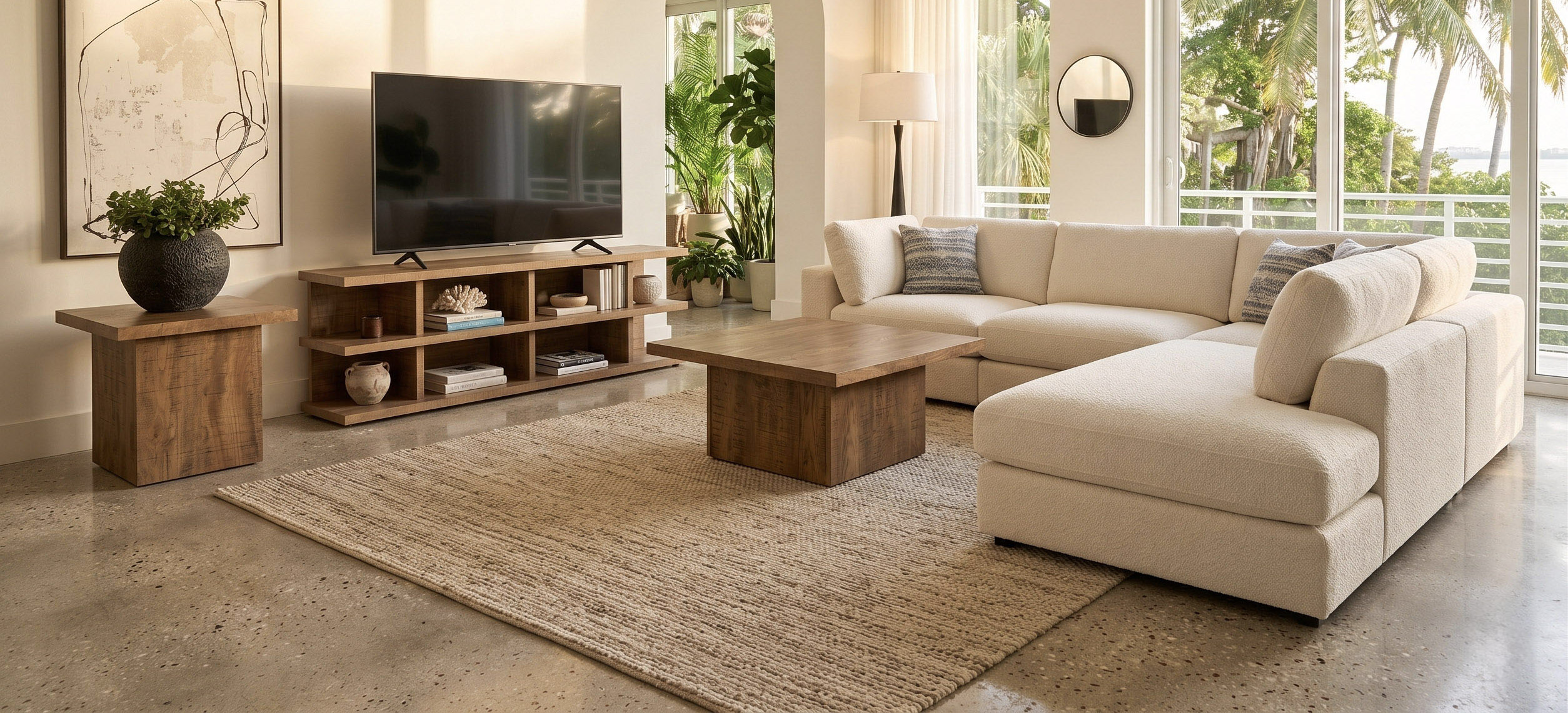
The single most common rug mistake in small spaces is using a rug that's too small. The front legs of the sofa should be on the rug. If the rug looks like a placemat under the coffee table, it's reading as clutter rather than as architecture. Bigger rugs make rooms feel bigger, almost regardless of the room's actual size.
7. Curved shapes beat sharp ones
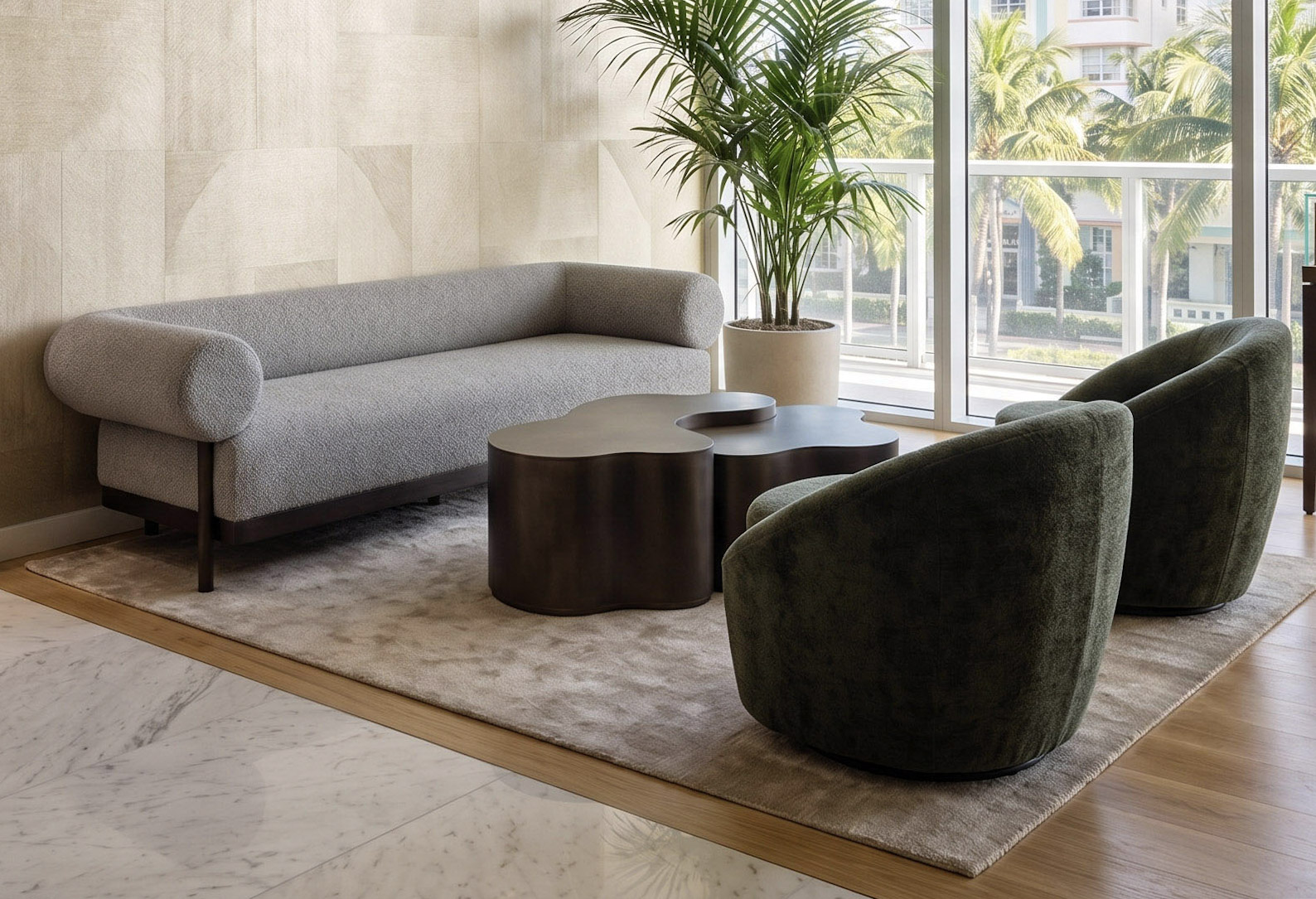
Sharp 90-degree corners — the L-shaped sectional, the rectangular dining table, the square coffee table — visually emphasize the room's boundaries. Curved shapes flow around them. In a small Miami apartment, a curved sofa, a round dining table, and a pebble-shaped coffee table create circulation paths that rectangular pieces interrupt.
This isn't a style choice as much as a spatial one. Two people moving through a small living room with a curved sofa pass each other naturally. Two people in a small living room with an L-shaped sectional have to negotiate the corner. Across 365 days, that friction adds up.
8. Vertical storage solves what horizontal storage can't
The instinct in a small apartment is to spread storage along walls — a low credenza, a long console, a wide media unit. The problem: that storage takes floor footprint that the room can't spare.
Vertical storage — narrow tall pieces that go up rather than out — solves the same problem with a fraction of the floor cost. A 16-inch-wide tall shelving unit holds more than a 60-inch-long low credenza and takes up a quarter of the floor space. The same logic applies to closets, bookcases, and even kitchen organization. In a small space, build up, not out.
9. Plants do disproportionate work
A single six-foot plant in a small Miami apartment performs three jobs at once: it adds vertical interest in a room that probably needs it, it softens the architectural angles of a condo's right-angle geometry, and it brings the outside in for residents who otherwise spend most of their time looking out at nature rather than inhabiting it.
The species that work in Miami high-rises are limited but reliable: snake plants for low-light corners, monstera or fiddle-leaf fig for indirect-light situations, ZZ plants for total neglect, pothos for trailing accents. In small spaces, one large plant usually does more work than several small ones.
10. The empty space matters as much as the filled space
This is the lesson everything else flows from: in a small apartment, the floor area you don't fill is part of the design. Designers in Miami who get this right typically leave 30–40% of the floor space genuinely empty — no furniture, no rugs, no accent pieces. That empty space is what makes the rest of the room feel intentional rather than crowded.
The temptation is to fill every corner with something useful. The discipline is to leave room to walk, breathe, and let the eye rest. A small apartment with three perfectly chosen pieces feels generous. A small apartment with seven good pieces feels small.
The five mistakes that make small spaces feel smaller
Worth naming the moves that consistently shrink Miami high-rises visually:
Dark furniture against dark walls. Espresso-finish pieces against a deep gray or navy accent wall absorb every photon of light. In a small space, this reads as the room closing in. Light colors on light walls, with one or two darker accent pieces, opens the same space dramatically.
Heavy curtains. Floor-to-ceiling drapes in heavy fabric in a small unit eat about 200 cubic feet of visual volume. Sheer panels or no curtains at all (most Miami buildings already have blinds) keep the window line and the ceiling line crisp.
Pattern overload. A patterned rug + patterned pillows + patterned curtains + patterned art = visual chaos. Pattern is fine, but one patterned element per room is usually the maximum a small space can carry.
Furniture pushed against every wall. The reflex is that pushing furniture against the walls "frees up space." It does the opposite — it creates an empty island in the middle and forces the eye to bounce between the walls. Pulling pieces in toward the center of the room (with empty space behind them) reads as more intentional and more spacious.
Open shelving as storage. Open shelves piled with everyday objects (cookbooks, mail, kids' toys, vitamins, candles) read as clutter regardless of how nicely the objects are arranged. In small spaces, closed storage almost always beats open storage.
How this applies to the rest of Miami
The principles above were observed in Brickell and Edgewater apartments — high-rises, open layouts, sub-1,000 square feet — but they generalize. Wynwood lofts work the same way. Coral Gables one-bedrooms in older mid-rise buildings work the same way. A 600-square-foot studio in any Miami neighborhood follows the same vocabulary.
The architectural details vary — bay views matter in Edgewater, city views in Brickell, industrial details in Wynwood, traditional moldings in older Coral Gables — but the design intelligence is shared: one hero piece per room, low-profile, layered lighting, restraint everywhere, plants doing disproportionate work.
Frequently asked questions
How do you make a small apartment look bigger?
The most reliable moves: low-profile furniture that doesn't interrupt window lines, light colors on walls and major pieces, layered lighting (three to four sources per room), one substantial mirror facing the largest window, large rugs that anchor the seating area rather than small rugs that read as clutter, and one or two transparent or translucent pieces (glass dining table, acrylic chairs) that visually disappear.
What's the most important piece of furniture in a small apartment?
The sofa. It's the largest piece, sets the visual tone for the room, and either obstructs the view or supports it. A curved, low-profile sofa with a 32-inch back height or lower fits a small Miami high-rise almost universally; an oversized L-shaped sectional rarely does.
How much furniture should a small apartment actually have?
Fewer pieces than people instinctively reach for. A 700-square-foot one-bedroom typically needs a sofa, two side tables, one coffee table, one console, one piece of art, one large plant, and a layered lighting setup. A bed, two nightstands, and a dresser in the bedroom. That's it. Anything beyond that should earn its square footage with a specific function.
Are curved sofas good for small spaces?
Yes — curved sofas often perform better than L-shaped sectionals in small Miami apartments. The curve creates circulation paths around the piece that sharp corners interrupt, and the silhouette feels less visually heavy. Lower back heights (32 inches or under) keep window lines clean.
What color palette works best for small spaces?
Light, warm, and consistent. Cream walls, light wood floors, sage or olive upholstery, terracotta or rust accents, and one or two darker objects for visual weight. The 2026 warm-minimalist palette translates especially well to small Miami high-rises because it keeps the room feeling open while avoiding the sterile feel of pure-white interiors.
Should I use a small rug or a large rug in a small apartment?
Larger than you think. The front legs of the sofa should be on the rug; the entire seating area should sit on or partially on it. Small rugs make rooms look smaller because they read as floating objects rather than as architectural anchors.
The honest bottom line
Small-space design in a Miami high-rise rewards restraint over abundance, scale over quantity, and intentional emptiness over filled corners. The designers who do this well in Miami treat each piece as a deliberate decision rather than an accumulation. The result is small spaces that feel substantially larger than their square footage — and that hold up across years of living rather than weeks of social-media documentation.
If you're furnishing a small Miami apartment in 2026, the playbook above is what works. The pieces don't have to be expensive. They have to be chosen carefully, kept few, and placed with the kind of discipline that small spaces specifically reward.
Furnish small spaces with the discipline they actually need
GROVI's curated collections are built around the small-space design vocabulary that works in Miami high-rises — curved low-profile sofas, sculptural lighting, light-finish wood, performance-grade textiles, and the kind of restraint that makes 700 square feet feel like 1,100. Browse the collections or talk to our team about a specific apartment.
.jpg)