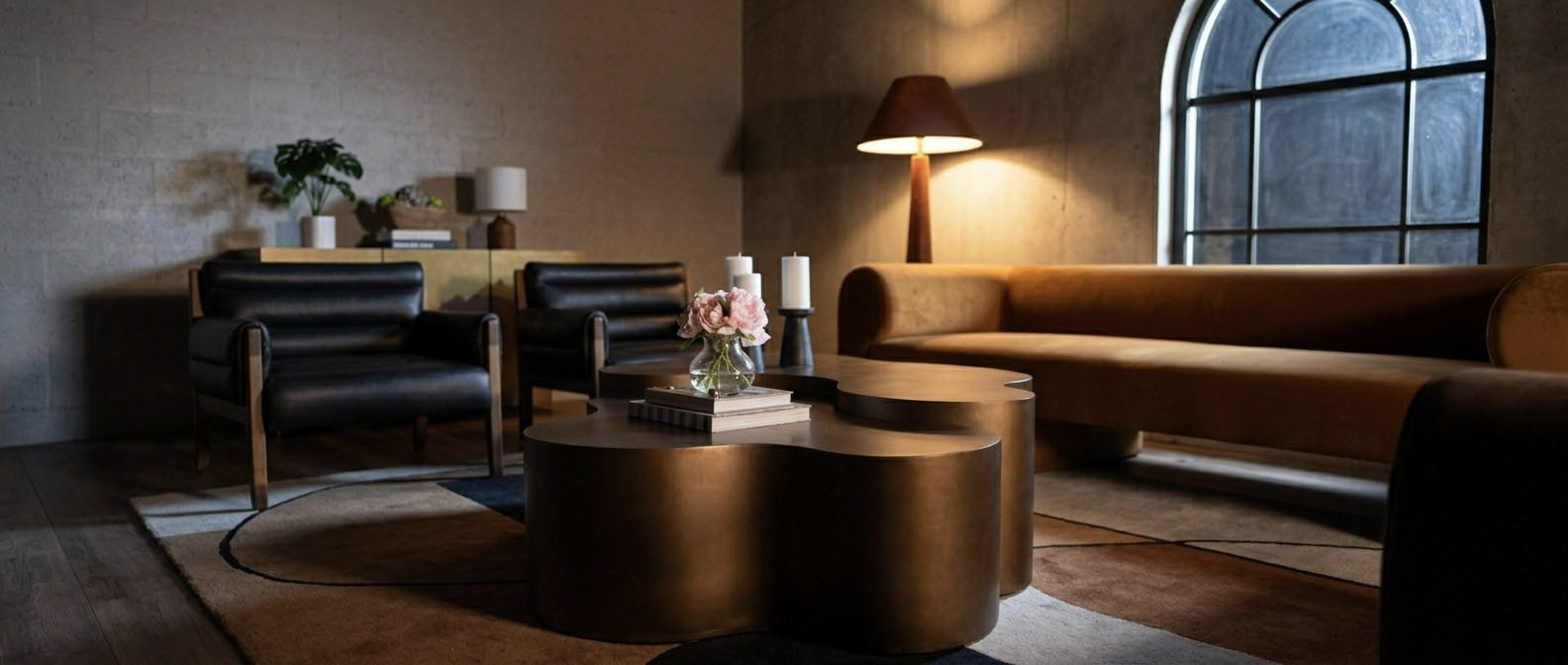
Lighting is the single most under-leveraged decision in most rental apartments. A $300 lighting setup will visibly improve a room more than a $3,000 sofa upgrade — and unlike furniture, lighting is portable, renter-friendly, and survives every move you'll make for the next decade.
This is the playbook for lighting a Miami apartment well, regardless of whether your overhead fixtures are good (rare), bad (common), or nonexistent (almost universal in older buildings). It's also the lighting playbook that GROVI's design team uses internally when furnishing a unit, simplified for renters working without a designer.
The one-line answer
Every well-lit room has three layers of light — ambient, task, and accent — and most apartments arrive with only one of them (overhead ambient) or none of them. The fastest, cheapest, most renter-friendly fix is to add two task lights and one accent light per main room. That's it. Five total fixtures in a typical one-bedroom apartment will outperform any single expensive overhead upgrade.
Why apartment lighting matters more than people think
Three reasons most rental apartments feel "off" the moment you walk in, even when the furniture is fine:
1. Single-source overhead lighting flattens everything. Developer-installed overhead fixtures cast even, shadow-free light across the ceiling — which sounds neutral but actually erases all the depth and dimension a room needs to feel inhabited. Every photograph of a "beautiful" apartment in design magazines has multiple light sources at multiple heights. Every photograph of a depressing rental apartment has one overhead fixture doing all the work.
2. Cool white light reads as "office," not "home." Most rental overhead fixtures ship with 4000K–5000K bulbs (cool white, slightly blue-tinted). This is correct for kitchens, conference rooms, and operating theaters. It is wrong for living rooms and bedrooms, where 2700K–3000K (warm white, slightly yellow) reads as residential. Swapping bulbs in your existing fixtures is the single cheapest design upgrade you can make — under $50 for an entire apartment.
3. Tall ceilings starve a room of light at human level. Miami high-rise apartments (Brickell, Edgewater, Wynwood lofts especially) have ceilings ranging from 9 to 14 feet. Overhead light has to travel 7–12 feet to reach the spaces where you actually live — the couch, the bed, the dining table. By the time it gets there, it's diffused into nothing. Lighting at the level you sit and stand is what makes a room feel warm and complete.
The good news: all three problems are solvable in a single afternoon with five well-chosen plug-in fixtures and no electrician.
The 3 layers of lighting (the foundation)
This is the framework professional designers use, simplified. Every well-lit room has all three layers, in roughly this balance:
Layer 1: Ambient lighting. The base layer that fills the room with general illumination. In most apartments, this is the developer-installed overhead fixture. In a well-designed room, ambient light can also come from large floor lamps with shades pointed upward, or from cove lighting if you're lucky. The role of ambient lighting is to make sure no part of the room is in complete darkness.
Layer 2: Task lighting. Focused light for specific activities — reading, cooking, working, vanity, dining. Task lights are typically at human level: table lamps next to chairs, desk lamps on workspaces, pendants over dining tables, sconces beside the bed. The role of task lighting is to make specific places in the room genuinely usable for specific functions.
Layer 3: Accent lighting. Light that exists to add warmth, depth, and atmosphere — not to illuminate any specific task. Picture lights over art, small lamps on bookshelves, candles, sculptural floor lamps that double as decor, LED strips behind a console. The role of accent lighting is to give the room visual interest and emotional warmth.
The mistake most rental apartments make is having only Layer 1 (the overhead) and nothing else. The second mistake is having only Layer 2 (a couple of desk lamps) and skipping accent. The fix is to make sure every main room — living room, bedroom, dining area, home office — has at least one of each layer.
The 5-fixture playbook for any apartment
These are the five lights every Miami apartment needs. Add them in roughly this order, depending on budget. None require an electrician. All are plug-in. All survive moves.
1. A floor lamp behind or beside the sofa
The single highest-leverage light in any apartment. Replaces or supplements your overhead living-room fixture; adds height and presence; pulls the eye toward the seating area; works as either ambient (if shade points up) or task (if shade points down). A 65"–75" floor lamp with a linen, paper, or fabric shade in a warm tone is the foundational living-room move. Sculptural arc lamps work especially well in apartments with high ceilings.
What to look for: 65"+ in height; warm white bulb (2700K–3000K); shade that diffuses rather than spotlights; weighted base so it doesn't tip on tile floors.
2. A pendant or fixture over the dining table
If your dining area has only a generic overhead can-light or no dedicated fixture at all, this is the room's single biggest aesthetic upgrade. A pendant centered over the dining table — hung 30–36" above the table surface — instantly defines the dining zone, adds vertical interest, and provides the warm focused light that makes dinners feel like dinners. Plug-in pendants with swag hooks are widely available for renters; no electrician needed.
What to look for: plug-in option with swag hook, or hardwire if your unit has a junction box; warm white bulb; size proportional to the table (typically 24"–30" wide for a 6-person table); finish that complements the rest of the room's metals (matte black, brushed brass, and aged bronze all work).
3. Two bedside table lamps
Bedrooms with only overhead lighting are the worst-lit rooms in most apartments. The fix is universal: two matching (or intentionally mismatched) table lamps on each side of the bed, ideally 24"–30" tall so the shade bottom is roughly at shoulder height when you're sitting up. Reading is the obvious use case; ambience is the bigger one. Bedside lamps turn a bedroom from "place I sleep" into "place I want to spend Sunday morning."
What to look for: matching or intentionally complementary pair; 24"–30" tall; warm white bulb; opaque shade for focused light or fabric shade for ambient glow; on a 3-way switch or with a smart bulb so you can dim for evening.
4. A task light for the home office or kitchen counter
Anywhere you do focused work — desk, kitchen prep area, makeup vanity — needs a dedicated task light. A desk lamp on the home-office surface; an under-cabinet LED strip in the kitchen; a vanity light at the bathroom mirror. This isn't decor; it's a functional requirement that overhead lighting cannot satisfy. The right desk lamp also reads on Zoom calls.
What to look for: for desks, an adjustable arm with a focused shade; for under-cabinet, plug-in LED tape with a warm white temperature; for vanity, two light sources at face height (sconces or a vertical bar fixture) rather than a single overhead.
5. An accent light for the room's "dark corner"
Every apartment has at least one corner that goes dark at night — the spot the overhead doesn't reach. The fix is a small accent light at that corner: a table lamp on a console, a floor lamp behind a chair, a small ceramic lamp on a bookshelf, a picture light on a piece of art. This is the light that converts a room from "lit" to "warm." Skip this and the room will feel incomplete no matter how much you spent on the other four.
What to look for: smaller scale than the main floor lamp; warm white bulb; sculptural form that doubles as an object in the room when off; ideally on a smart plug or timer so it comes on automatically at sunset.
Room-by-room: how to apply the 3 layers
Living room
Minimum lighting setup:
- One overhead ambient fixture (provided) with bulbs swapped to 2700K warm white
- One floor lamp behind or beside the sofa (the #1 fixture from the playbook)
- Two table lamps on console or end tables for accent and additional task light
- Optional: picture light over art
Total fixtures: 4–5. The room will look like a designed space, not a rental.
Bedroom
Minimum lighting setup:
- One overhead ambient fixture (provided) with bulbs swapped to warm white — or skipped entirely if the bedside lamps are strong enough
- Two matching bedside table lamps (the #3 fixture from the playbook)
- Optional: a small accent light on a dresser or bookshelf
Total fixtures: 3. The bedroom is the room where the warm-white bulb swap matters most. A bedroom lit at 4000K will keep you awake; the same fixture at 2700K will help you sleep.
Dining area
Minimum lighting setup:
- One pendant or chandelier over the table (the #2 fixture from the playbook)
- That's it. The dining area doesn't need other light sources — the pendant does the entire job if it's the right scale and warmth.
Total fixtures: 1. The dining pendant is the single most underrated upgrade in apartment lighting.
Home office
Minimum lighting setup:
- One overhead ambient fixture (provided)
- One desk task lamp at the workspace (the #4 fixture from the playbook)
- One accent light somewhere in the room — for video-call backgrounds, this is the difference between looking professional and looking like you're working from a cave
Total fixtures: 3. The accent light specifically matters for camera-on calls; without it, you'll look flat and underlit on Zoom no matter how good your camera is.
Kitchen
Minimum lighting setup:
- One overhead ambient fixture (provided), bulbs at 3000K (slightly cooler than living spaces — kitchens are the one room where cool white is acceptable)
- Under-cabinet task lighting along the countertop work zone (plug-in LED strips, $30–$80 from Amazon or IKEA)
Total fixtures: 2. Under-cabinet lighting is the single biggest functional upgrade you can make to a rental kitchen.
Bathroom
Minimum lighting setup:
- One overhead ambient fixture (provided)
- Vanity lighting at face height — ideally two sources (sconces on either side of the mirror) rather than a single overhead bar. This is the lighting that matters for makeup, shaving, and seeing what you actually look like.
Total fixtures: 2 (the vanity fixture often counts as one). If your bathroom only has the overhead, even a small clip-on light on the mirror frame helps.
Miami-specific lighting considerations
Five things that matter for Miami apartments specifically:
1. The light coming in your windows is more intense than almost anywhere else in the U.S. South Florida sunlight is bright, hot, and directional. Sheer curtains, woven shades, or solar shades that diffuse rather than block keep daytime interiors livable. Without diffusion, your apartment will be either blindingly bright (mornings) or overheated (afternoons).
2. Humidity affects fixture choice. Standard metal finishes corrode in coastal humidity, especially in bay-facing units (Brickell, Edgewater, South Beach, Sunny Isles). Powder-coated metals, brass with a sealed finish, ceramic, and glass survive humidity better than chrome or untreated brass. Salt-adjacent units (anywhere with direct bay or ocean exposure) should specifically avoid raw iron and unsealed copper.
3. Most Miami high-rise overhead fixtures are bad. Developer-installed can lights and flush mounts in Brickell, Edgewater, and Coral Gables condo towers are functional at best, ugly at worst. Plug-in supplemental lighting is more cost-effective than swapping the fixtures (which usually requires the condo association's approval and is rarely worth the fight).
4. Tall ceilings need taller lighting. A 32"-tall table lamp in a 12-foot-ceiling Edgewater or Wynwood loft looks miniature. In tall-ceiling units, scale up: 30"+ table lamps, 75"+ floor lamps, pendants that drop meaningfully into the room.
5. Hurricane preparedness means rechargeable backup lighting matters. Battery-powered or USB-rechargeable lamps are worth keeping around. When the power goes out for two days in September, a $40 rechargeable lamp is the difference between a livable evening and one spent on your phone flashlight.
What to rent vs. what to buy
Most lighting fixtures are worth owning — they're portable, they don't depreciate the way furniture does, and they survive every apartment move. But there's a meaningful subset that's better rented:
Worth owning (buy): table lamps and floor lamps you genuinely love; bedside lamps (always come with you); smart bulbs and plugs (move with you); rechargeable backup lamps.
Worth renting (or skipping): dining pendants sized for a specific table you don't yet own; statement floor lamps you're not sure about long-term; anything dramatically scaled to a specific apartment (the 90" arc lamp that works in your current loft won't fit your next 9-foot-ceiling unit); coordinated lighting packages where you want a designer-curated look without the buying decisions.
GROVI's design-led collections include curated lighting as part of every package — floor lamps, table lamps, accent lighting, and where applicable, dining pendants — selected to match the rest of the collection's wood, metal, and textile vocabulary.
Common apartment lighting mistakes
Six mistakes that turn otherwise-good apartments into dim or harsh ones:
Mistake 1: Cool white bulbs in living spaces. 4000K–5000K bulbs anywhere outside the kitchen or bathroom will make the room read as commercial. Swap to 2700K for living and bedroom, 3000K for kitchen and home office.
Mistake 2: Relying on a single overhead source. A room with only one light source will feel flat no matter the wattage. The fix is multiple sources at multiple heights — even three cheap fixtures beat one expensive one.
Mistake 3: Lamps that are too short. Table lamps under 24" and floor lamps under 60" disappear in most living rooms and look toy-sized in tall-ceiling units. Scale up.
Mistake 4: No dimming. Light that can't dim is light you'll either avoid using or use too brightly. Smart bulbs (Philips Hue, LIFX, Wyze) and smart plugs (TP-Link, Amazon) give you dimming on any fixture for $15–$50.
Mistake 5: Forgetting the dining table. A dining table without dedicated overhead light reads as a workspace, not a dining area. A single pendant transforms it.
Mistake 6: Skipping accent lighting. The room's "dark corner" is the test. If you can identify a corner that's noticeably dim at night, the room needs one more accent fixture.
Frequently asked questions
How many lights should I have in an apartment?
A typical one-bedroom apartment is properly lit with 8–12 light sources total — the overhead fixtures plus 5–9 supplemental plug-in fixtures across the main rooms. A studio needs 5–7. A two-bedroom apartment needs 12–18. The exact count matters less than the principle: every main room should have ambient, task, and accent lighting layers.
What's the best lighting for a rental apartment?
Plug-in lighting — floor lamps, table lamps, plug-in pendants, smart bulbs in existing fixtures, under-cabinet LED strips. None require permission from your landlord, none require an electrician, and all move with you to your next apartment.
What color temperature should apartment bulbs be?
2700K (warm white) for living rooms, bedrooms, and dining areas. 3000K (also warm but slightly cooler) for home offices and kitchens. 3500K–4000K only for bathrooms and kitchens where task accuracy matters most. Anything above 4000K reads as commercial or institutional in residential settings.
How do I light an apartment without overhead lighting?
Use two large floor lamps with shades pointed upward (uplighting) as your ambient layer; add table lamps for task and accent. A bedroom without overhead lighting needs two bedside table lamps plus a small accent light minimum. The principle is the same as in any room: three layers, multiple sources, multiple heights.
How can I improve bad apartment lighting cheaply?
The two cheapest, highest-impact upgrades: swap your bulbs to 2700K warm white (under $50 for the whole apartment) and add a single 65"+ floor lamp behind the sofa ($150–$400). These two changes alone will transform any apartment. Add bedside lamps and a dining pendant next if budget allows.
Do I need a pendant over my dining table?
Yes, if the dining area is a defined zone in your apartment. A pendant transforms an undefined floor space into an actual dining room. Plug-in pendants with swag hooks work for renters; no electrician needed.
What's the best lighting for video calls and working from home?
A task light on or above the desk for general visibility, plus a small accent light or lamp positioned behind the camera to add depth to the background. Front lighting matters more than overhead — never have a window or bright light directly behind you, and aim for soft, even lighting on your face.
How do I light a high-ceiling Miami loft?
Scale up. Standard-sized lamps disappear in 11–14-foot-ceiling units. Use 75"+ floor lamps (or arc lamps), 30"+ table lamps, and pendants that drop meaningfully into the room (typically 30–40 inches below the ceiling for living rooms, 30–36 inches above the table for dining).
Are smart bulbs worth it in a rental?
Yes, for two reasons: they let you dim any fixture without rewiring, and they move with you. A starter set of 4–6 smart bulbs ($40–$120 total) plus a smart plug for the lamps without sockets will give you dim-from-phone control across the whole apartment.
The bottom line
Lighting is the highest-leverage design decision in any apartment — and the easiest to get right. Three layers, five fixtures per room, warm bulbs, multiple sources at multiple heights. A $300 lighting setup will outperform any single expensive furniture upgrade, and unlike furniture, lighting follows you to every apartment you'll live in for the next decade.
If you're furnishing a Miami apartment from scratch and want lighting handled as part of a coordinated package — selected to match the wood, metal, and textile vocabulary of the rest of the room — GROVI's design-led collections include curated lighting in every package.
Furnish your apartment with lighting included
GROVI's design-led collections include curated lighting — floor lamps, table lamps, accent lighting, and dining pendants — coordinated to match the rest of each collection's design vocabulary. Delivered and installed within 48 business hours for in-stock orders. Entry-level collections start at $307/month; design-led collections start at $400/month.
.jpg)
.jpg)
.jpg)