Most "how to furnish an Airbnb" guides are written by people who've never operated in a market where the average listing competes against 4,000 others within five miles, where summer humidity destroys cheap furniture in 18 months, and where a single hurricane evacuation can mean weeks of unfurnished re-supply. Miami is one of those markets.
This is a step-by-step playbook for furnishing a Miami short-term rental — Airbnb, VRBO, Booking.com, or direct-bookings — in the order a host should actually do the work. Ten steps, executed in sequence, from "I just got the keys" to "I'm taking the listing photos." It's the playbook GROVI's team uses when hosts bring us in at the planning stage, simplified for hosts working without a designer.
The one-line answer
A well-furnished Miami short-term rental needs three things working in concert: design that photographs better than your direct competitors (guests book from photos), durability that survives 80+ check-ins per year without looking worn, and a furnishing approach that lets you adjust the inventory as the market changes. For most new hosts and many existing ones, renting furniture rather than buying it solves all three at once.
Before you start: three things to know
1. Furniture matters more for STRs than for residential rentals. A residential couch sees one or two people on it daily. An STR couch sees a different group every 3–4 days, often with kids, drinks, sunscreen, and luggage. The performance bar is meaningfully higher and the photographic bar is the entire game.
2. Guests book from photos before they read anything. The first 5–7 listing photos drive the booking decision. The furniture in those photos is doing 80% of the work that words and amenity lists do for residential rentals.
3. Climate compresses your replacement cycle. Salt air, humidity, hurricane-related power outages, and intense UV all degrade furniture faster in Miami than in any cold-climate STR market. Performance-grade materials aren't optional.
With those three premises set, the 10 steps follow.
Step 1: Confirm your building permits short-term rentals
Do this before you spend a dollar. Most Brickell, Edgewater, Wynwood, and Coral Gables condo buildings either prohibit STRs entirely or require 30+ day minimum stays. South Beach, Mid-Beach, North Beach, Sunny Isles, Aventura, Surfside, and STR-friendly parts of Coconut Grove are more permissive. The City of Miami Beach and Miami-Dade County both regulate STR licensing.
Action items:
- Pull your condo association's current rules in writing (an email from management, not a verbal "yes")
- Check current City of Miami Beach and Miami-Dade County STR regulations (rules shift annually)
- If you're in a single-family home, check zoning rules for your specific street and lot
- Apply for licensing before you furnish — the licensing timeline can run 4–12 weeks in some jurisdictions
If your building doesn't permit STRs: stop here. Either re-zone your strategy (mid-term furnished rentals in the 30–120 day range work in many of these buildings) or find a different unit.
Step 2: Study the top 20 competing listings in your neighborhood
Open Airbnb in incognito mode and search your neighborhood and bed count. Sort by superhost, then by review score, then by booking velocity. Save the top 20 listings to a Pinterest board or a slide deck.
What you're looking for:
- The dominant aesthetic in your specific neighborhood and price tier (Wynwood reads industrial-modern; Coconut Grove reads tropical; South Beach reads art deco-modern)
- The standard furniture pieces every top listing has (sofa silhouette, dining table type, bedroom configuration)
- The differentiators — what makes a listing photograph as memorable rather than generic
- The price-per-night your direct competitors charge at your bed count
Output of this step: a clear visual reference for what "good" looks like in your specific neighborhood and price tier, plus a target nightly rate.
Step 3: Set your budget and decide buy vs. rent
For a 2-bedroom Miami STR aiming for the mid-to-upper market, the realistic budget is $18,000–$30,000 to buy STR-grade furniture outright, or $700–$1,300/month for an all-in rental contract that includes performance-grade pieces, delivery, install, replacement provisions, and pickup.
The buy case (limited): you're a long-term host (5+ years) in a stable property you own; your nightly rate justifies the capital outlay; you have the operational bandwidth to source, install, store, and replace pieces independently.
The rent case (broader): new host launching in 2026 (rent for the first 12 months to test the listing before committing capital); multi-property host (rental contracts scale operationally faster than buy-and-store); you want furnishing handled as a service — delivery, install, replacement, and pickup included; you want hurricane-season replacement provisions built into your contract.
The hybrid case (often optimal): buy the bed, mattress, and major case goods you know you'll keep; rent the photogenic soft furniture (sofas, accent chairs, dining tables, lighting) that will need refresh on a 2–4 year cycle.
Decide your approach before moving to Step 4. The rest of the steps assume you've made this call.
Step 4: Buy or rent the bed and mattress first
The mattress is the single biggest review driver in any STR. A bad mattress generates 1- and 2-star reviews almost regardless of what else is right. Start here.
Mattress specs to look for:
- Hotel-quality construction (Beautyrest, Sealy Posturepedic Hotel Series, Marriott-spec, or equivalent)
- Hybrid spring-and-foam is the safer choice for varied guest preferences
- 6–10 year STR lifespan with proper rotation
Bed frame specs:
- Heavy-duty construction (flimsy frames squeak and break under stress-test use)
- Substantial headboard (drives the #1 photographable bedroom element)
- Storage drawers if your unit is space-constrained
Action items:
- For each bedroom, specify mattress, bed frame, two matching bedside tables, two matching lamps
- If buying: this is one of the categories worth buying outright if you'll keep it through multiple guests
- If renting: confirm the rental contract includes mattress replacement on a 5–7 year cycle
Step 5: Choose the sofa
The sofa is the second-highest review driver and the single biggest photo-booking driver. Choose carefully.
What to specify:
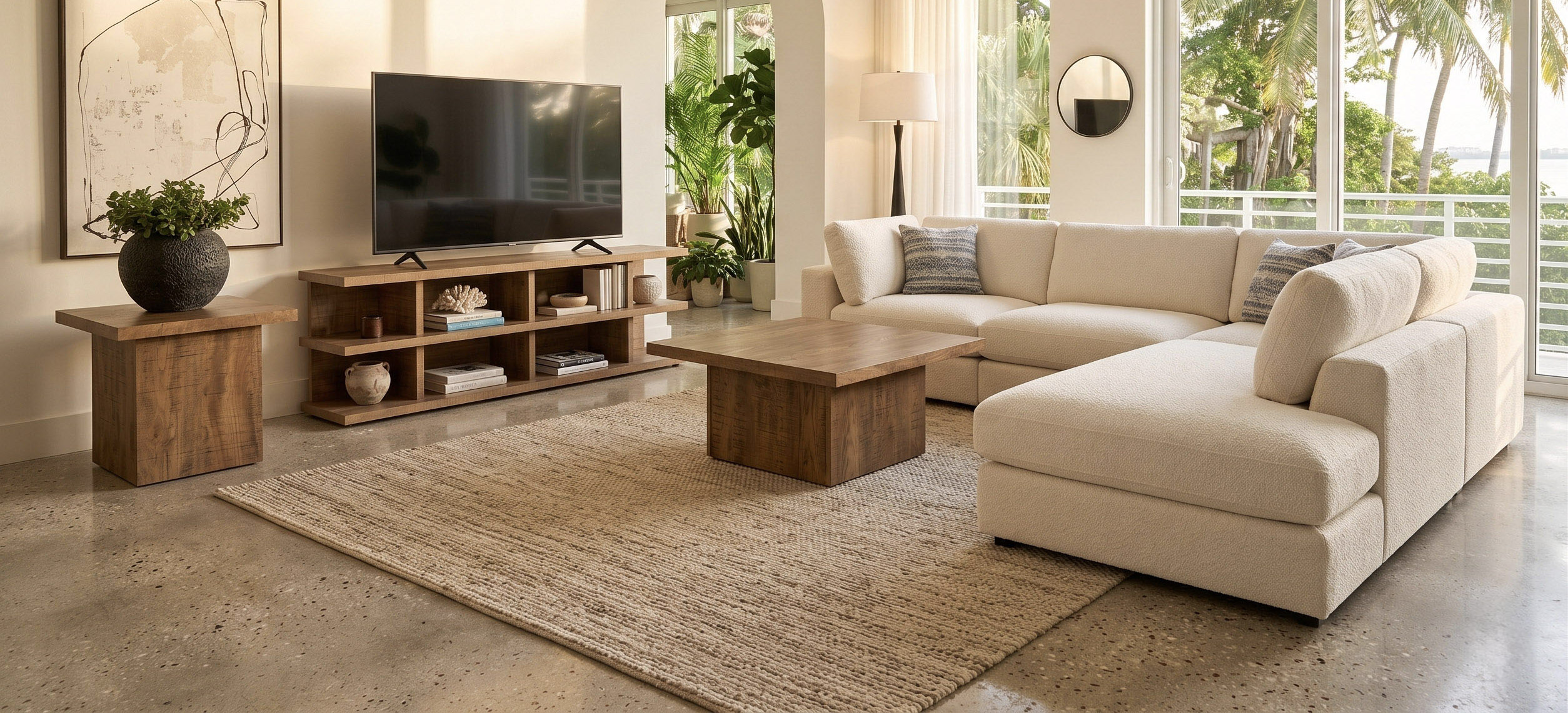
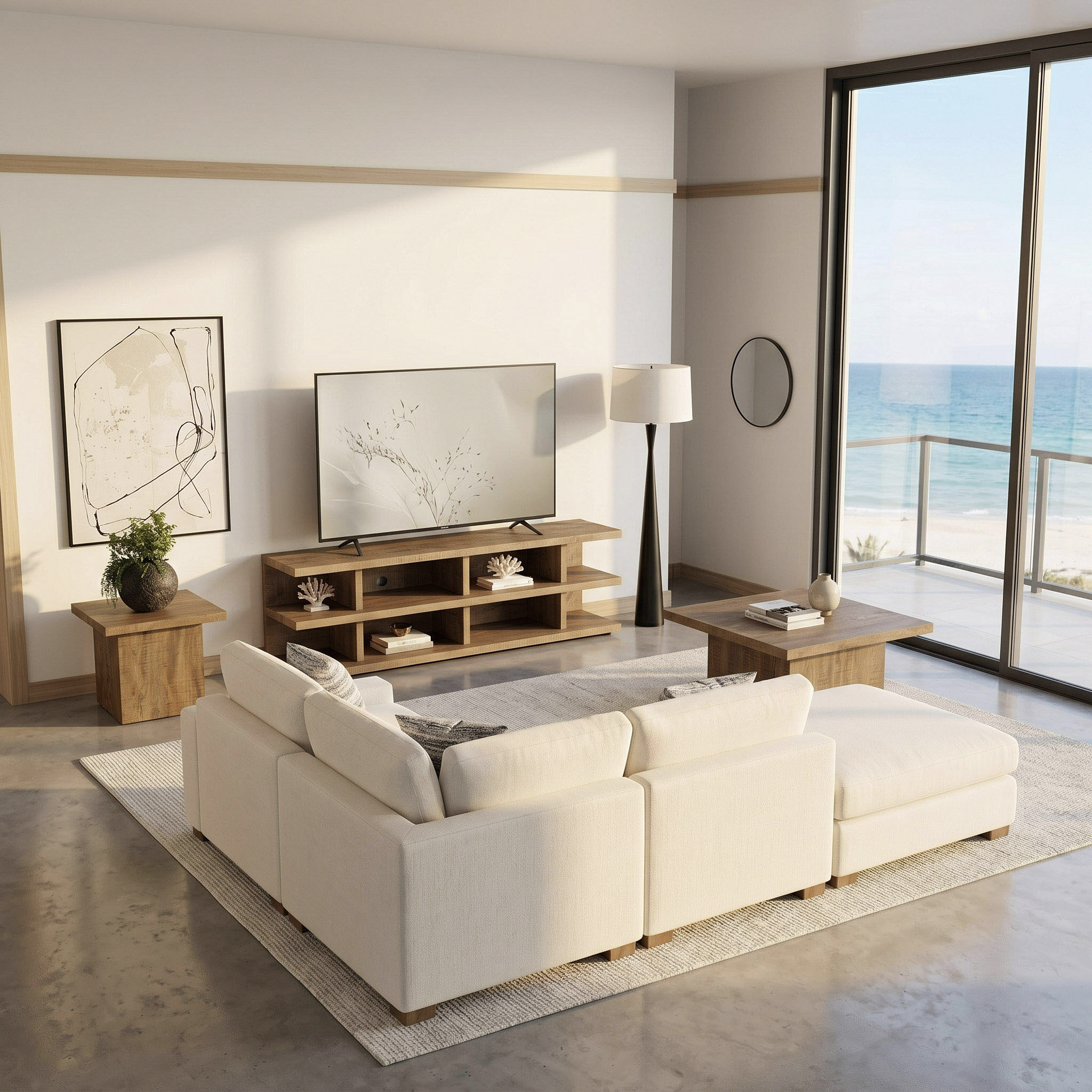
- Silhouette: generous, substantial, photogenic. Sectionals for larger units, generous 3-seaters for smaller. Avoid pale-gray rental-grade pieces; they read as forgettable in photos.
- Color: warm neutrals (cream, taupe, terracotta, deep olive) outbook pale gray at the same nightly rate.
- Fabric: performance-grade only (Sunbrella, Crypton, performance velvet, performance bouclé, washable linen, or high-quality leather). Avoid pure cotton, untreated linen, suede, and basic microfiber.
- Configuration: plan for the listing photos. A sectional plus one accent chair often outperforms two sofas because the chair adds compositional variety.
Action items:
- Compare your sofa choice against the top 20 listings from Step 2
- Verify the fabric spec is genuinely performance-grade (ask the vendor for the abrasion-resistance rating and stain-resistance treatment specifics)
- Confirm seat depth and back height are guest-friendly (not just photogenic)
Step 6: Set up the dining area
A 2-bedroom STR needs seating for 4–6 at the dining table, not just 2. Booking algorithms favor listings that can host the maximum on the listed bed count. The dining setup is the single most underrated upgrade in apartment STR furnishing.
What to specify:
- Table: round or oval tables seat more per square foot than rectangular ones in tight spaces. Specify a table sized for your listed sleeping capacity.
- Chairs: real chairs with proper backs (not stools or benches). Upholstered or fully-formed chairs photograph better than wire or bistro chairs and are more comfortable for long meals.
- Pendant lighting: a pendant centered 30–36" above the table transforms an undefined floor space into an actual dining room. Plug-in pendants with swag hooks are widely available for renters with no junction box.
Action items:
- Confirm the dining table seats your full listed capacity
- Add a pendant or properly-scaled chandelier above the table
- Style the table for the listing photos (one set of tablescape props is enough; don't over-stage)
Step 7: Build a workspace
Remote-work-era booking patterns favor listings with usable workspaces. Listings that show a desk and chair in photos rank higher for the substantial share of guests booking 4+ night stays — which is where most STR margin sits.
What to specify:
- Desk: at minimum 36" wide; a real desk, not a folding card table
- Chair: a real desk chair, not a dining chair pulled up (guests will leave reviews about this specifically)
- Lighting: a desk lamp with a 3000K warm-white bulb
- Power: a power strip with USB ports at the desk
Action items:
- Identify the workspace location (bedroom corner, console behind the sofa, dedicated nook)
- In studios, use a small console or folding desk that emerges from a closet
- Always include the workspace in your listing photos
Step 8: Layer your lighting
Single-source overhead lighting will make even good furniture photograph as flat and unfriendly. Every well-lit room has three layers: ambient, task, and accent. Most rental apartments arrive with only one (overhead) or none.
The 3-layer rule applied to STRs:
- Ambient: the provided overhead, with bulbs swapped to 2700K warm white (under $50 for an entire apartment)
- Task: floor lamp behind/beside the sofa, two bedside lamps in each bedroom, desk lamp at the workspace, pendant over the dining table
- Accent: one small lamp per room's "dark corner" — usually a console table lamp, a picture light over art, or a sculptural floor lamp in an unused corner
Action items:
- Swap every bulb in the apartment to 2700K warm white (3000K in kitchen and bathroom only)
- Add minimum 5 supplemental plug-in fixtures to a 1-bedroom unit (more for larger units)
- Add smart bulbs or smart plugs to enable dimming on every fixture ($15–$50 per fixture)
For the full lighting playbook, see our apartment lighting guide.
Step 9: Furnish the bedrooms and add outdoor furniture
Bedrooms first, then outdoor. Bedrooms drive review scores; outdoor drives nightly rate.
Bedroom essentials (per bedroom):
- High-quality mattress and bed frame (covered in Step 4)
- Two matching bedside table lamps (covered in Step 8)
- A dresser or storage piece (real, not under-bed bins)
- Blackout curtains or shades (drives both review scores and energy bills)
- A full-length mirror somewhere visible
Outdoor (balcony, patio, terrace, yard):
- A small lounge or chaise per balcony
- A bistro table and two chairs at minimum, larger sets if space allows
- Outdoor cushions in performance fabric
- Solar string lights (cheap, photograph beautifully, drive social-media-style listings)
Action items:
- Per bedroom, photograph from the doorway after staging — that's the angle guests will see
- For outdoor: anything you put outside must survive Miami year-round. Avoid weather-sensitive accent pieces.
- Outdoor furniture is one of the highest-ROI photo investments for Miami STRs; budget $100–$400/month if renting
Step 10: Plan for replacement and damage management
STR furniture in Miami needs replacement on a 3–5 year cycle for soft pieces and 5–8 years for case goods, even with performance materials. Plan for it now, not when a guest stains your sofa six months in.
Cash reserve approach (for hosts buying outright): set aside 5–10% of annual gross revenue as a furniture replacement reserve; inventory every piece with purchase date and expected replacement year; identify your local replacement supply chain ahead of need (the wrong time to find a sofa supplier is when guests are checking in tomorrow).
Contract approach (for hosts renting): confirm your rental contract includes replacement provisions for high-wear pieces; confirm the replacement turnaround is fast enough for an active STR (48 hours is the right standard); confirm hurricane-season provisions are included (replacement guarantees, accelerated re-delivery after major storms, cushion storage during named-storm warnings).
Action items:
- Choose your approach in advance
- Document the policy in your operations manual so a property manager or co-host can execute when you're not available
- Treat damage management as an operational system, not an emergency response
Miami-specific factors hosts often miss
A few neighborhood and climate factors that compound on top of the 10 steps:
Hurricane season is a furnishing factor. Plan for the possibility of a 5–10 day evacuation per year. Furniture that can be moved to an interior windowless room (sofa cushions, smaller chairs, lamps) reduces hurricane damage exposure. After a major storm, replacement supply chains can take 4–8 weeks — rental contracts with built-in replacement become especially valuable.
Salt air corrodes specific finishes. For bay-facing and ocean-facing units (Brickell, Edgewater, South Beach, Sunny Isles, Surfside, parts of Coconut Grove), specifically avoid raw iron, untreated brass, and chrome. Powder-coated steel, ceramic, glass, sealed brass, and treated outdoor-rated finishes survive.
Humidity affects wood and upholstery. Solid hardwood furniture can crack and warp through Miami summers if not kiln-dried. Engineered wood and plywood-core pieces actually perform better in many Miami contexts than solid hardwood. Upholstery without anti-microbial treatment can develop mildew — performance-grade fabrics solve this.
South Florida UV is intense. Direct-sun-facing units fade upholstery and bleach woods faster than in most U.S. markets. UV-resistant fabrics, light-finish woods that hide bleaching, and window treatments that diffuse rather than block all extend furniture life.
How GROVI handles STR hosts specifically
GROVI works with Miami short-term rental hosts across most of the city's STR-zoned markets — South Beach, Mid-Beach, North Beach, Sunny Isles, Aventura, Surfside, and STR-friendly parts of Coconut Grove, Wynwood, and Mid-Beach.
Coordinated photo-ready collections. GROVI's design-led collections are curated for the warm-minimalist aesthetic that consistently outperforms generic rental-grade furniture in STR photos.
Performance-grade specs by default. Sofas, dining chairs, and bed frames in GROVI's design-led collections ship with performance-grade upholstery, durable case-good construction, and finishes built for high-turnover use.
48-hour delivery for in-stock orders. A new listing can go from empty unit to photo-ready in 48 business hours, including COI and building-access coordination.
Replacement built into STR contracts. GROVI's STR-specific contracts include built-in replacement provisions for high-wear pieces.
Multi-property pricing. Hosts running multiple Miami STR properties typically qualify for portfolio pricing — better unit economics on the second, third, and fourth property than on the first.
Hurricane preparedness. STR contracts can include hurricane-season provisions (replacement guarantees, accelerated re-delivery after major storms, optional cushion storage) that hosts buying outright don't have access to.
What it costs to furnish a Miami STR (2026)
Working monthly rental ranges for STR-optimized packages:
- Studio (1 bedroom equivalent), STR-optimized: $350–$550/month
- One-bedroom STR-optimized package: $450–$800/month
- Two-bedroom STR-optimized package: $700–$1,300/month with multi-room pricing
- Three-bedroom STR-optimized package: $1,000–$1,900/month with multi-room pricing
- Four-bedroom single-family STR: quote-based, typically $1,600–$3,500/month
- Outdoor furniture add-on: $100–$400/month depending on scope
STR pricing typically runs slightly higher than residential rental of the same unit because the collections include performance-grade upgrades, additional pieces for photographable composition, and built-in replacement provisions.
For context: buying the equivalent STR-grade furniture for a typical 2-bedroom Miami STR outright runs $18,000–$30,000 — and the buy-equivalent is the more expensive math whenever your hold period is under 3–4 years per piece. A $700/month STR package over 3 years totals $25,200 and includes replacement, delivery, install, and pickup that buying does not.
8 common Miami STR furnishing mistakes
1. Buying cheap-now to save money. Cheap furniture in a Miami STR will look worn within 12 months and need replacement within 24. Early replacement plus the bad reviews along the way costs more than buying right the first time.
2. Furnishing for what you'd like, not what photographs and rents. Study the top 20 listings in your neighborhood and price tier before specifying anything.
3. Skipping the workspace. You'll lose the 4+ night bookings that drive most STR margin.
4. Forgetting outdoor. Outdoor furniture is one of the highest-ROI photo investments. Skip it and you're competing with one hand tied.
5. Underlighting. Single-source overhead lighting will make even good furniture photograph as flat and unfriendly. Three layers, every room.
6. Generic gray everything. Pale-gray rental-grade furniture photographs as forgettable and books at lower rates than character-forward pieces in warm-traditional or tropical-modern palettes at the same nightly price.
7. Not planning for replacement. STR furniture will need replacement on a 3–5 year cycle. Either budget for it or contract for it.
8. Renting STRs in buildings that prohibit them. Confirm your building permits STR use before furnishing. The number of Miami hosts who furnish first and discover the rules after is non-trivial.
Frequently asked questions
How much should I spend on furniture for an Airbnb in Miami?
For a 2-bedroom Miami STR aiming for the mid-to-upper market, budget $18,000–$30,000 for outright purchase of STR-grade furniture, or $700–$1,300/month for an all-in rental contract that includes performance-grade pieces, delivery, install, replacement provisions, and pickup.
Should I buy or rent furniture for my Miami Airbnb?
For most new Miami STR hosts, renting wins for the first 12–24 months — it lets you test the listing before committing capital, includes replacement provisions for damage, and adjusts to design-cycle shifts. Established multi-property hosts often run hybrid models (buying durable case goods, renting photogenic soft furniture). Pure-buy is rarely optimal in Miami's STR market given the climate, turnover, and design-trend dynamics.
What furniture should I prioritize for a vacation rental in Miami?
In rough priority order: the mattress (drives reviews), the sofa (drives photo bookings), the dining setup (drives review scores from longer stays), lighting (drives photo quality), a workspace (drives 4+ night bookings), outdoor furniture (drives nightly rate). Underinvest in accent pillows, decorative books, and bench-at-foot-of-bed pieces.
What's the best fabric for Airbnb upholstery in Miami?
Performance-grade fabrics — Sunbrella, Crypton, performance velvet, performance bouclé, washable linens, high-quality leather. Avoid pure cotton, untreated linen, suede, and basic microfiber. Performance fabrics last 3–5x longer than standard upholstery in high-turnover STR use and forgive spills, sunscreen, and humidity.
How do I make my Miami Airbnb photograph better?
Three biggest levers: warm-white lighting (2700K bulbs throughout, multiple sources at multiple heights), photogenic sofa with substantial silhouette and warm-cream-or-deeper neutral upholstery, and a dining pendant that defines the dining zone. Skip pale gray everything. Add real plants. Photograph mid-morning with curtains diffusing direct sun.
Are there furniture rental companies that work with Miami Airbnb hosts?
Yes. GROVI is one of them; the Q4 2025 Relo acquisition combined design-led collections with the entry-level Miami Collection, covering the full STR price range. GROVI's specific STR-host services include performance-grade specs, replacement provisions, hurricane-season coverage, multi-property pricing, and 48-hour delivery.
Does my Miami building allow short-term rentals?
Varies widely. Most Brickell, Edgewater, Wynwood, and Coral Gables condo buildings either prohibit STRs entirely or require 30+ day stays. South Beach, Mid-Beach, North Beach, Sunny Isles, Aventura, Surfside, and STR-friendly parts of Coconut Grove are more permissive. Confirm with your condo association and check current City of Miami Beach and Miami-Dade County STR regulations before furnishing or listing.
How often do I need to replace Airbnb furniture in Miami?
With performance-grade pieces and proper care: 3–5 years for soft furniture (sofas, chairs, mattresses) and 5–8 years for case goods (dressers, dining tables, beds). With cheap-grade pieces: 12–24 months for soft furniture, 3–4 years for case goods. The climate, turnover frequency, and salt-air exposure all compress the replacement cycle relative to inland or cold-climate STRs.
What's the ROI on outdoor furniture for a Miami Airbnb?
Strong. Outdoor furniture is one of the highest-impact photo investments for Miami STRs because the outdoor space photographs as a major amenity and books accordingly. A $100–$400/month outdoor add-on typically returns 5–15% in higher nightly rate and improved booking velocity on units with usable outdoor space.
The bottom line
A Miami short-term rental is more like a small hotel than a residential apartment. The furniture has to photograph well, survive high-turnover use, withstand the climate, and adapt as the market shifts. Buying outright optimizes for one of those things (control) at the cost of the other three. Renting through a furniture partner that builds replacement and refresh into the contract optimizes for all four — and is the right approach for most new hosts and many established ones.
Execute the 10 steps in sequence. Confirm the building rules first, study your competition second, set the budget third, and work from the bed outward. Skip any step and you'll be back to fix it within six months of going live.
Furnish your Miami short-term rental the right way
GROVI furnishes Miami short-term rentals with performance-grade design-led collections, 48-hour delivery on in-stock orders, replacement provisions built into STR-specific contracts, multi-property pricing for hosts scaling up, and hurricane-season coverage that hosts buying outright can't access. Entry-level STR-optimized packages from $450/month; design-led packages from $700/month; outdoor furniture add-ons from $100/month.
.jpg)
.jpg)