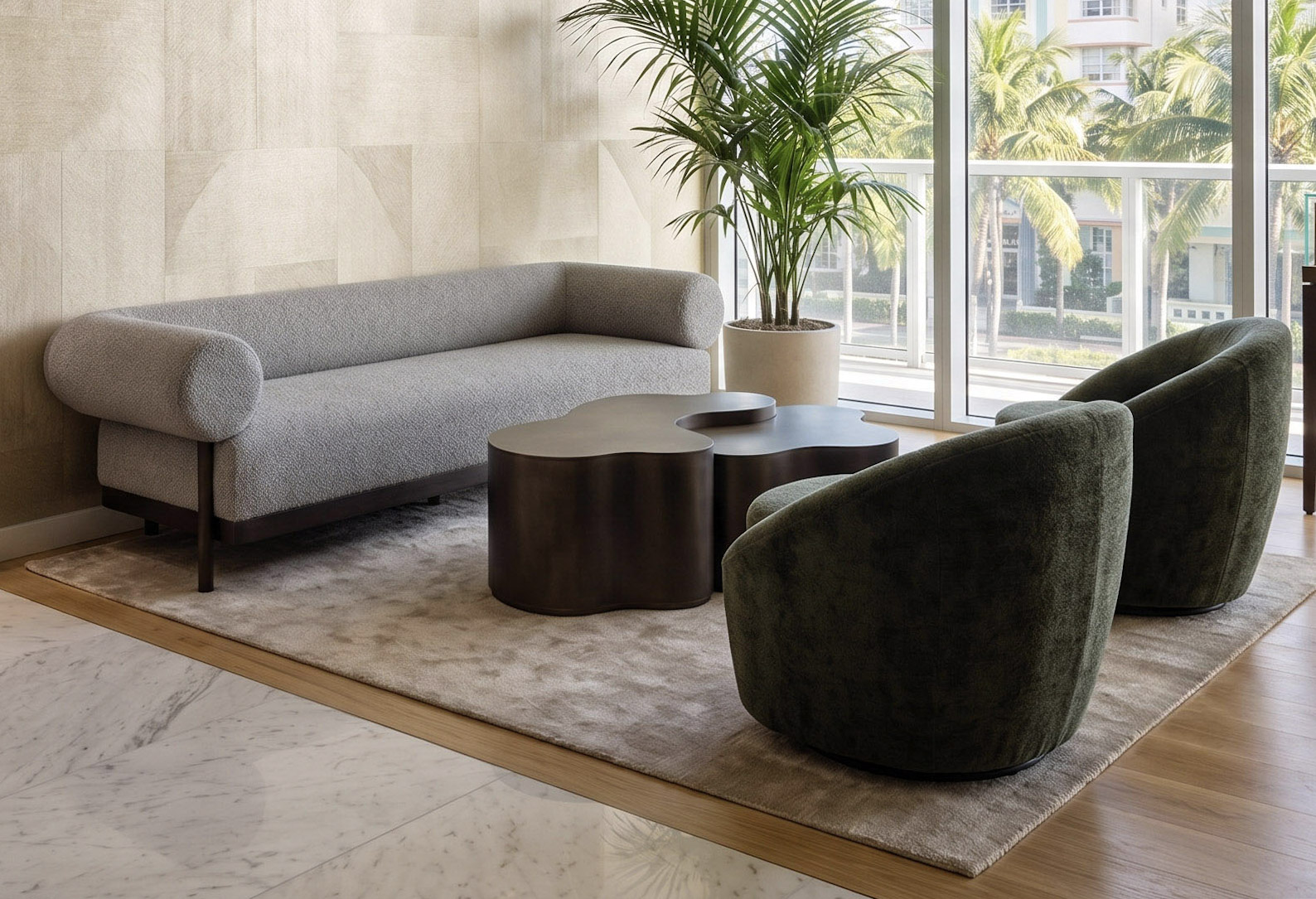
"How much does furniture rental cost?" is the first real question most people have, and it's usually answered with a frustrating "it depends." It does depend — but on a small number of clear factors, and once you know them, you can estimate your cost within a tight range before you ever request a quote. This guide breaks down exactly what furniture rental costs in Miami in 2026, what drives the number up or down, what to watch for in the fine print, and how to pay the least for the most.
Everything here reflects real 2026 South Florida pricing. Use it to budget, to compare providers, and to know a fair quote when you see one.
The short answer
For a standard one-bedroom Miami apartment, furniture rental costs $307/month for an entry-level collection and $400–$700/month for a design-led collection — all-in, with delivery, assembly, installation, and pickup included. Studios start around $250/month; two-bedrooms run $400–$1,200/month; larger homes scale from there.
The single most useful reframe: a $307/month entry-level collection delivers furniture with a retail value of roughly $6,000–$7,000. So the real question isn't "is renting cheap?" — it's "how do I get several thousand dollars of quality furniture into my apartment without paying for it all up front?" That's what the monthly price buys.
What furniture rental costs by unit size (2026)
Here's the full residential range. All prices are monthly and all-in (delivery, assembly, installation, and pickup included):
- Studio (full furnishing): $250–$450/month
- One-bedroom, entry-level: $307/month (or $277/month with the 10% student discount)
- One-bedroom, design-led: $400–$700/month
- Two-bedroom, entry-level: $400–$650/month
- Two-bedroom, design-led: $700–$1,200/month
- Three-bedroom: $600–$1,800/month depending on collection
- Four-bedroom / single-family home: quote-based, typically $1,500–$3,200/month
- Outdoor furniture (add-on): $75–$400/month depending on scope
Where you land within each range comes down to the factors below.
The 6 things that drive the price
Furniture rental pricing isn't mysterious. Six factors move the number, and understanding them lets you predict and control your cost:
1. Unit size and number of rooms. The biggest driver, and the most obvious — more rooms and more square footage mean more furniture. A studio costs a fraction of a four-bedroom. Multi-room packages scale, but often with a per-room discount (see "how to save" below).
2. Which collection you choose. This is the second-biggest lever. Entry-level collections (like GROVI's Miami Collection) cover the essentials at the lowest price; design-led collections use higher-end pieces, better materials, and more curated styling for a proportionally higher monthly cost. The gap between entry-level and design-led is often the difference between the low and high end of a size range.
3. Term length. Longer commitments usually lower the monthly rate; very short terms can carry a premium. If you know you'll stay a year, saying so often gets you a better monthly number than an open-ended or month-to-month arrangement.
4. What's included in the package. A living-room-only package costs less than a whole-apartment package. Add-ons — a home office, outdoor furniture, extra bedrooms, housewares — each add to the monthly total. Decide what you actually need furnished.
5. Delivery and logistics. With a good provider, delivery, assembly, installation, and pickup are included in the monthly price (they are with GROVI). Watch for providers that charge these separately — it can add meaningfully to the real cost (see "hidden costs" below).
6. Your use case. Specialized packages price differently. Short-term-rental (Airbnb) packages run higher because they include performance-grade materials and replacement provisions. Corporate and staging packages are scoped and often volume-priced. A standard residential package is the baseline.
Price by use case
Furniture rental isn't one product — different users pay differently:
Residential (the baseline). The per-unit ranges above. A resident furnishing their own apartment.
Students. The lowest effective pricing, thanks to the 10% student discount — a $307/month one-bedroom becomes $277/month, and roommates splitting a multi-room apartment can stack the multi-room discount on top.
Short-term rental hosts. $350–$3,500/month depending on unit size, running slightly higher than residential because packages include performance-grade materials built for turnover and built-in replacement provisions.
Corporate relocation. $350–$3,500/month per unit, with volume pricing for companies and relocation managers placing multiple employees.
Property staging. Quote-based, scoped to the listing and the staging timeline.
Hidden costs to watch for (and what should be free)
The advertised monthly rate isn't always the real cost. When comparing providers, check whether these are included or extra:
Should be included (and are, with GROVI):
- Delivery — some providers charge a separate delivery fee
- Assembly and installation — building the furniture and setting it up
- Styling — arranging it to look designed, not just dropped off
- Pickup at the end — collection when your term ends
- Building coordination — the COI and freight-elevator scheduling most Miami buildings require
Usually separate (and reasonable):
- Optional damage waiver — typically a small percentage of the monthly rent, covering normal wear and accidents. GROVI uses a simple deposit with an optional waiver — no separate insurance policy or third-party claims process required.
- Housewares — kitchen items, linens, towels, where offered (common in corporate and STR packages)
Watch for these red flags:
- Delivery, assembly, or pickup billed as separate line items that balloon the real cost
- Required separate insurance policies with third-party claims processes
- Long mandatory minimum terms with steep early-termination fees
- Unclear or add-on pricing for building COIs
The all-in monthly rate is the honest way to price furniture rental. When you compare quotes, compare all-in totals — not just the headline number.
Renting vs. buying: the cost comparison
The most common question behind the cost question is: wouldn't it be cheaper to just buy? Here's the honest math:
Cost to buy, outright:
- One-bedroom, furnished with mid-quality furniture: $8,800–$13,600
- Two-bedroom: $15,000–$25,000
Cost to rent, over time (design-led one-bedroom at ~$500/month):
- 1 year: $6,000
- 2 years: $12,000
- 3 years: $18,000
How to read this:
- For short stays (1–2 years), renting is clearly cheaper once you account for the upfront capital, plus delivery, assembly, and eventual disposal of bought furniture.
- Around the 2–3 year mark, the cumulative rental cost approaches the purchase price — this is the rough crossover point.
- For long, stable stays (4+ years) in a home you control, buying usually wins on pure cost.
But pure cost isn't the whole picture, especially in Miami: buying ties up capital up front; Miami's climate depreciates owned furniture fast, so you don't recoup much on resale; renting includes the logistics (delivery, assembly, pickup, building coordination) that buying makes your problem; and renting is flexible for the uncertain or seasonal horizon that describes a large share of Miami residents.
The honest bottom line: if you're staying 4+ years and value ownership, buy. For shorter, uncertain, or seasonal stays — most of Miami — renting costs less in practice and delivers far more furniture quality per dollar up front.
How to pay the least (without cutting corners)
Several legitimate ways to lower your furniture rental cost:
Ask about the multi-room discount. GROVI offers 10% off, with higher discounts for multi-room rentals — even on entry-level collections. Furnishing more rooms (or splitting a multi-room apartment with roommates) unlocks better per-room pricing. It's not always advertised; just ask.
Use the student discount if you qualify. 10% off for students, stackable with the multi-room discount for roommates furnishing together.
Commit to a term if you can. A defined term (a year, a lease length) often gets a better monthly rate than open-ended or month-to-month.
Right-size the package. Furnish the rooms you actually use. If you rarely dine at a table, or don't need a home office, don't pay to furnish those — add them later if that changes.
Start entry-level, upgrade if needed. The entry-level collection delivers real furniture ($6,000–$7,000 retail value) at the lowest price. You can always move up to design-led; you don't have to start there.
Compare all-in quotes, not headline rates. The lowest advertised monthly rate can become the most expensive once separate delivery, assembly, insurance, and pickup fees are added. All-in pricing (like GROVI's) is usually the better real value.
Frequently asked questions
How much does it cost to rent furniture for an apartment?
For a one-bedroom in Miami, $307/month for an entry-level collection or $400–$700/month for design-led, all-in (delivery, assembly, installation, and pickup included). Studios start around $250/month, two-bedrooms run $400–$1,200/month, and larger homes scale from there. A $307/month collection delivers roughly $6,000–$7,000 in retail furniture value.
Is renting furniture worth the cost?
For short, uncertain, or seasonal stays — which describe a large share of Miami residents — yes. It costs less than buying once you account for the upfront capital, delivery, assembly, disposal, and Miami's fast furniture depreciation, and it delivers far more furniture quality per dollar up front. For long, stable stays of 4+ years, buying usually wins on pure cost.
What's included in the furniture rental price?
With a good provider, the monthly price includes delivery, assembly, installation, styling, pickup at the end, and building coordination (the COI and freight-elevator scheduling Miami buildings require). Optional damage waiver and housewares are usually separate. Watch for providers that charge delivery, assembly, or pickup as separate fees — compare all-in totals.
Why does furniture rental cost more for some apartments than others?
Six factors: unit size (more rooms cost more), which collection you choose (entry-level vs. design-led), term length (longer often cheaper monthly), what's included (add-ons like a home office or outdoor furniture), delivery and logistics (should be included), and use case (STR and corporate packages price differently). Unit size and collection are the two biggest levers.
How can I make furniture rental cheaper?
Ask about the multi-room discount (10% off with higher discounts for more rooms), use the student discount if you qualify, commit to a defined term, right-size the package to the rooms you actually use, start with an entry-level collection, and compare all-in quotes rather than headline rates. Roommates furnishing a multi-room apartment together get the best per-person pricing.
Is furniture rental cheaper than buying?
For stays under about 2–3 years, yes — the cumulative rental cost stays below the purchase price plus logistics and depreciation. Around 2–3 years is the rough crossover. Beyond 4 years in a stable home, buying usually wins on pure cost. But renting also avoids tying up capital, includes all the logistics, and sidesteps Miami's fast furniture depreciation.
Are there any hidden fees in furniture rental?
There can be, depending on the provider. Some charge separate delivery, assembly, or pickup fees, or require separate insurance policies — which balloon the real cost beyond the headline rate. A good provider (like GROVI) includes all of that in one all-in monthly price, with only an optional damage waiver and optional housewares priced separately. Always compare all-in totals.
How much does it cost to furnish a whole apartment?
Depends on size and collection: a full one-bedroom runs $307–$700/month, a two-bedroom $400–$1,200/month, and a three-bedroom $600–$1,800/month, all-in. Multi-room discounts lower the per-room cost as you furnish more of the apartment. Compare that to $8,800–$25,000+ to buy the equivalent outright — a large upfront cost renting spreads into a predictable monthly one.
The bottom line
Furniture rental in Miami costs $307/month for an entry-level one-bedroom and $400–$700/month for design-led, all-in, scaling up with size and down with discounts — and the number is predictable once you know the six factors that drive it. The smartest way to think about the cost isn't "cheap vs. expensive"; it's "how do I get thousands of dollars of quality furniture into my home, set up and hassle-free, for a predictable monthly cost, without tying up capital or getting stuck with furniture I'll have to sell?" For most Miami residents, that's exactly the value the monthly price delivers.
When you compare quotes, compare all-in totals, ask about the multi-room and student discounts, and right-size the package to what you'll actually use. Do that, and you'll pay the least for the most.
Get an exact quote for your apartment
GROVI furnishes apartments across Miami-Dade, Broward, and Palm Beach with all-in monthly pricing — delivery, assembly, installation, styling, and pickup included, with a simple deposit and optional damage waiver. Entry-level collections from $307/month; design-led from $400/month; multi-room and student discounts on request. Delivered and set up within 48 business hours for in-stock orders.

.jpg)
.jpg)